Butyl Rubber Stopper for Medical Glass Vial with Screw Neck

13mm Butyl Rubber Stopper for Glass Injection Vials (HVRS008)

Butyl Stopper Black Color for Injection Vial Use Size 20mm

Butyl Rubber Stopper (HVRS001)

20mm Butyl Rubber Stopper (HVRS006)

I have found results from3000+products and1000+suppliers aboutButyl rubber stoppers vial


Butyl rubber is preferred due to its exceptional gas and moisture barrier properties, which are critical for maintaining the stability of sensitive drugs. It offers high chemical resistance and low extractables, ensuring that the stopper does not contaminate the medication. For specialized applications, Bromobutyl or Chlorobutyl variants are often used as they provide superior resealability and lower fragmentation during needle penetration.
Suppliers must adhere to ISO 8871 (Elastomeric parts for parenterals) and USP <381> (Elastomeric Closures for Injections). For products entering the EU, compliance with EP 3.2.9 is mandatory. Ensure the manufacturer provides a Certificate of Analysis (CoA) and is registered with the FDA (DMF - Drug Master File) if you are targeting the U.S. market.
Buyers should choose between RFS (Ready-for-Sterilization) and RFS (Ready-to-Use) stoppers. RTU stoppers are pre-washed and sterilized (usually via Gamma radiation or Steam), which reduces the buyer's operational burden. Ensure the supplier operates in a Class 100 (ISO 5) cleanroom environment for the final packaging stage to prevent particulate contamination.
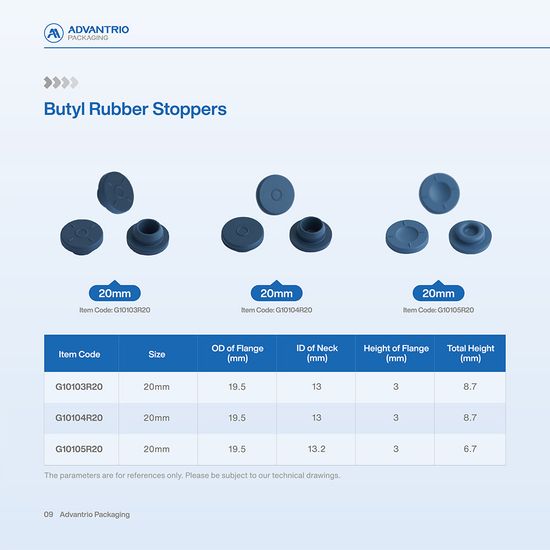
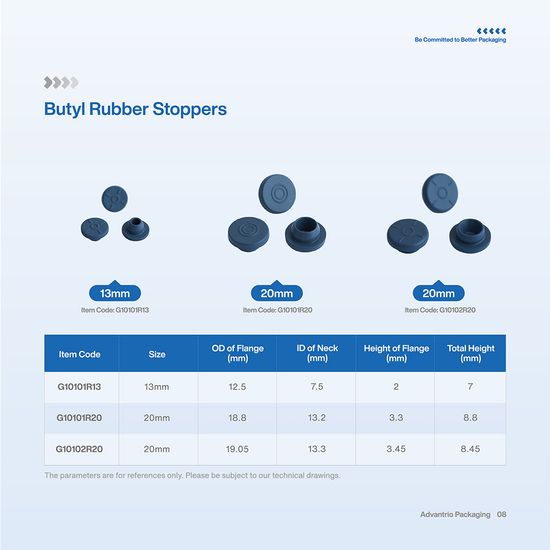
The flange diameter and leg length must precisely match the vial's neck finish (e.g., 13mm, 20mm, or 32mm). Additionally, the hardness (Shore A) should typically fall between 40-50 to balance ease of insertion with a tight seal. For lyophilized (freeze-dried) drugs, specific two-leg or three-leg designs are required to allow vapor escape during the drying process.
Insist on double or triple vacuum packaging using medical-grade PE bags. Request that the supplier uses heavy-duty outer cartons and pallets to prevent punctures. For high-value pharmaceutical components, sourcing through verified manufacturers on Made-in-China.com allows you to check for ISO 15378 (Primary packaging materials for medicinal products) certifications before shipping.
Focus on long-term quality stability rather than just the lowest price. Negotiate for batch-to-batch consistency guarantees and ask for a fixed price agreement for 6-12 months to avoid fluctuations in raw rubber costs. Request free samples (50-100 pcs) to conduct compatibility tests with your specific vials before committing to a bulk order.
Use Secured Payment services provided by platforms like Made-in-China.com to ensure funds are only released upon proof of shipment. For large volumes, consider a third-party pre-shipment inspection (such as SGS or Intertek) to verify the particulate matter levels and dimensional accuracy against the agreed specifications.
Check the HS Code (typically 4016.99) for specific import duties in your country. Be aware that medical components may require Import Licenses or registration with your local health authority (e.g., EMA in Europe or ANVISA in Brazil). Ensure all Customs Invoices clearly state the 'Medical Grade' nature of the product to avoid delays in quarantine.