
Satisfies 1 requirement
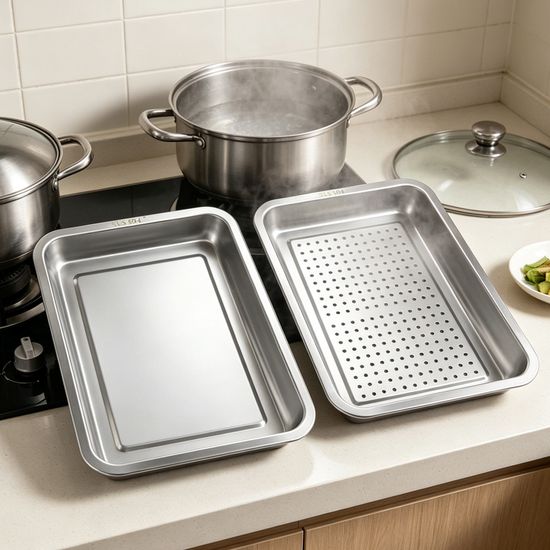
1/1 Gn Pan Gastronorm Container 15 Cm Stainless Steel Food Tray
US$7.50-8.50
6 Pieces(MOQ)

I have found results from200000+products and60000+suppliers aboutStainless steel tray



The choice of material grade is critical for durability and safety. For food service and medical applications, prioritize Grade 304 (18/8) stainless steel due to its excellent corrosion resistance and non-reactive properties. For high-end laboratory or marine environments, Grade 316 is recommended as it contains molybdenum, providing superior resistance to chlorides and chemicals. For budget-friendly decorative or dry-storage use, Grade 201 may be used, but it is more prone to rusting in humid conditions.
Ensure the trays are produced using deep-drawing or hydraulic pressing for seamless construction, which prevents bacterial growth in corners. The surface should be electropolished or mirror-polished to enhance corrosion resistance and ease of cleaning. For industrial use, check for burr-free edges (rolled edges) to ensure worker safety. If the tray is for medical use, verify that it can withstand autoclave sterilization without warping.
For food-contact trays, suppliers must provide FDA (US) or LFGB (EU) certification to ensure no harmful heavy metals leach into food. If sourcing for the medical sector, look for ISO 13485 quality management systems and CE marking. General manufacturing quality should be backed by ISO 9001 certification to ensure batch-to-batch consistency.
Request the material thickness (gauge) specifications; typically, 0.8mm to 1.2mm is standard for commercial trays. Thinner trays may flex under heavy loads. Ask for load-test reports if the trays are intended for heavy industrial parts. Additionally, check for reinforced ribs or corrugated bottoms which significantly increase rigidity without adding excessive weight.
Material fraud is a common risk. Always request a Material Test Report (MTR) or a Mill Test Certificate (MTC). For large orders, it is highly recommended to hire a third-party inspection service (like SGS or Intertek) to perform an XRF (X-ray fluorescence) analyzer test on-site before shipment to confirm the nickel and chromium content matches the order specifications.
Focus on Total Cost of Ownership (TCO) rather than just the unit price. Negotiate based on volume-based pricing tiers, and ask for customized packaging (e.g., foam interleaving) to prevent scratching during transit. Clearly define the Incoterms (e.g., FOB or CIF) in the contract and use Secured Trading Services provided by the platform to protect your payment until the goods pass inspection.
Stainless steel trays are heavy and prone to surface scratching. Ensure the supplier uses PE bags for individual wrapping and 5-layer corrugated export cartons. For LCL (Less than Container Load) shipping, insist on palletization with plastic wrap and corner protectors to prevent compression damage. Verify the HS Code (typically 7323.93 for kitchenware) to accurately calculate import duties in your destination country.
Establish a Quality Agreement before placing the order that defines the 'Acceptable Quality Level' (AQL 2.5/4.0 is standard). Include a clause for remedies for defectives, such as a refund or replacement in the next shipment. Always document the unboxing process with video evidence if damage is found, and file a claim through the platform's dispute resolution center immediately.