
Satisfies 1 requirement
Stainless Steel Work Table for Commercial Kitchen/Restaurant/Hotel/Food Factory
US$30.00-100.00
2 Pieces(MOQ)

I have found results from200000+products and70000+suppliers aboutStainless steel food table


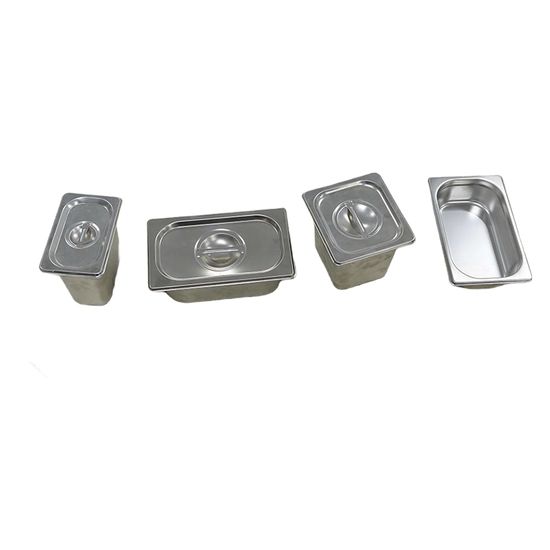


The most critical factor is the grade of stainless steel. For food contact, Grade 304 (18/8) is the industry standard due to its excellent corrosion resistance. For highly acidic environments or heavy brine exposure, Grade 316 is preferred. Avoid Grade 201 for long-term food use as it is prone to rusting in humid kitchen environments. Additionally, ensure the gauge (thickness) is appropriate; 14 to 16 gauge is ideal for heavy-duty commercial use, while 18 gauge is suitable for light prep work.
To ensure food safety and hygiene, the product should ideally be NSF (National Sanitation Foundation) certified, which guarantees the design is easy to clean and free of bacteria-trapping crevices. For the European market, compliance with EC 1935/2004 is necessary. You should also request Material Test Reports (MTRs) from the supplier to verify the chemical composition of the steel matches your requirements.
Look for 'coved' corners (rounded) on the backsplash and tabletops to prevent dirt accumulation. For stability, prioritize tables with stainless steel legs and adjustable bullet feet rather than galvanized steel, which can peel and rust. If the table is for a central kitchen, a flat top is best; if it is placed against a wall, a backsplash (usually 4-inch) is essential to protect the wall from splashes and food debris.
Ensure the table features hat channels (reinforcement ribs) underneath the tabletop to prevent bowing and reduce noise (sound deadening). The load capacity should be clearly stated; professional-grade tables should support at least 500 to 800 lbs of distributed weight. Check that the undershelf is also made of stainless steel and is adjustable to accommodate different equipment heights.
Request a pre-shipment inspection (PSI) and specifically ask the inspector to perform a 'molybdenum test' or use an XRF analyzer to confirm the steel grade. You should also require the supplier to provide clear photos of the welding points, as poor welding is where rust typically starts. Using Made-in-China.com's Secured Trading services can provide an extra layer of payment protection until the quality is verified.
To reduce shipping volume and costs, opt for Knock-Down (KD) packaging rather than fully welded units. Ensure the supplier uses reinforced 5-layer corrugated cartons with edge protectors and internal foam padding to prevent dents during transit. For large orders, FOB (Free On Board) is generally more cost-effective as it allows you to use your own freight forwarder to negotiate better sea freight rates.
Many manufacturers on Made-in-China.com offer OEM services. When negotiating, provide a detailed CAD drawing or technical sheet. If your order is below the standard MOQ (typically 20-50 units), offer to pay a sample fee for the first unit, which can often be deducted from the bulk order later. Always clarify if the price includes customized labeling or laser-etched branding on the table surface.
Always conduct transactions through verified channels and avoid direct transfers to private bank accounts. Use Letter of Credit (L/C) for very large volumes or Telegraphic Transfer (T/T) with a 30% deposit and 70% balance against the Bill of Lading (B/L). Ensure all specifications, including steel grade, gauge, and packaging method, are explicitly written into the Proforma Invoice (PI) to serve as legal evidence in case of disputes.